The Influence of Progressive Jackpot Layers on Standard Reel Spins Across Wolf Gold, Immortal Romance, and Thunderstruck II
Casey Schmidt · Sep 4, 2026

The Influence of Progressive Jackpot Layers on Standard Reel Spins Across Wolf Gold, Immortal Romance, and Thunderstruck II
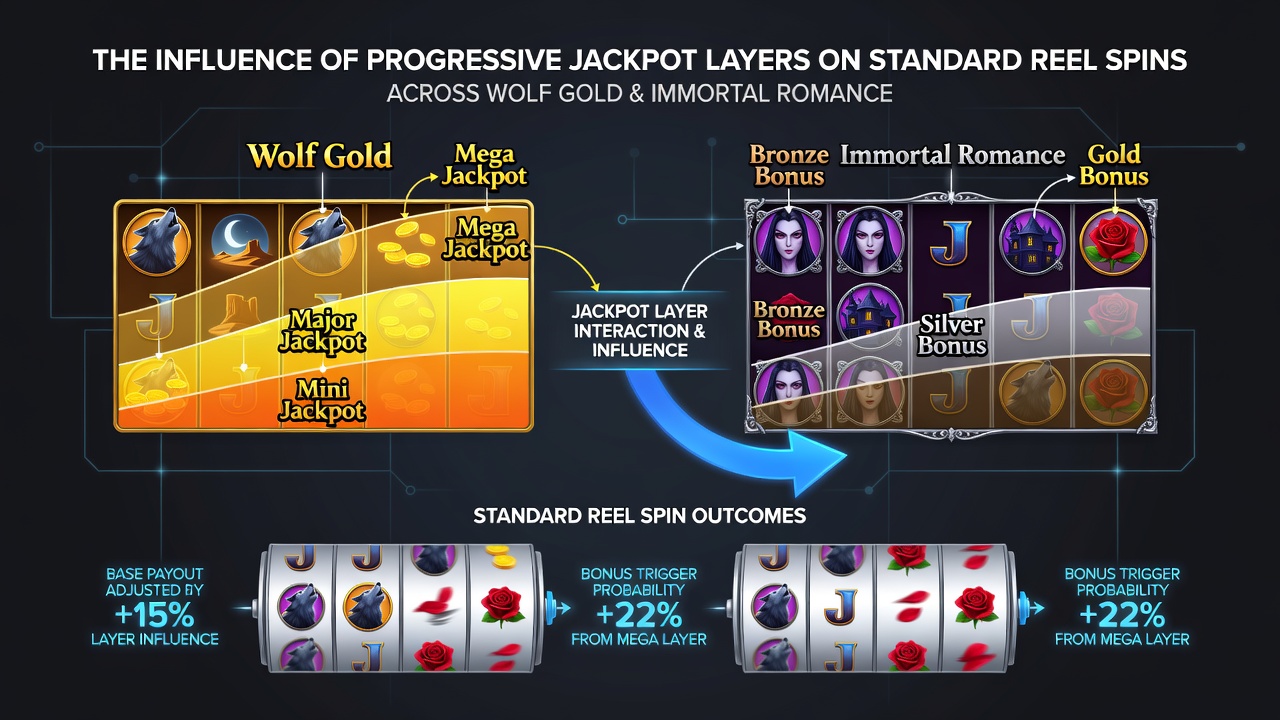
Progressive jackpot layers in modern video slots alter the distribution of outcomes during standard reel spins by diverting a percentage of each wager into growing prize pools, and this mechanism operates across Wolf Gold from Pragmatic Play, Immortal Romance from Microgaming, and Thunderstruck II also from Microgaming. Observers note that the contribution rate typically ranges between 0.5 and 2 percent of every bet placed on the base game, which directly reduces the return-to-player percentage allocated to regular symbol combinations while creating the potential for the large linked prizes.
Mechanics of Jackpot Integration in Each Title
Wolf Gold routes a fixed portion of base spins into three progressive tiers labeled Mini, Minor, and Major, whereas Immortal Romance ties its jackpot feature to a separate wheel that activates after specific symbol alignments during normal play, and Thunderstruck II channels contributions into the Thunderstruck progressive network that spans multiple titles on the same platform. Data from slot analysis reports indicate that these layers maintain the core reel mathematics yet shift the frequency of certain mid-tier payouts because the jackpot seed and increment absorb part of the theoretical payout budget.
Base Spin Dynamics Under Progressive Contribution
Standard reel spins in these games continue to follow their published paytables and volatility profiles even as the jackpot meter climbs, but the effective hit frequency for non-jackpot wins decreases proportionally to the contribution rate, and researchers have documented this adjustment through long-term simulation runs that isolate the jackpot component. In Wolf Gold the free-spin feature with sticky wilds remains unchanged by the progressive layer, while Immortal Romance preserves its 243-ways-to-win structure and character-driven bonus rounds; Thunderstruck II keeps its 243-ways layout and wild multipliers intact during ordinary spins. The progressive element only influences the overall return allocation rather than modifying reel strips or symbol probabilities on any given spin.
Industry figures reveal that platforms operating these titles update their jackpot meters in real time, and as of September 2026 several operators have introduced daily contribution caps that prevent any single game from feeding more than a set amount into the pool during peak traffic hours. This adjustment stabilizes the growth rate of the progressive prizes without altering the underlying reel mathematics that players encounter on every spin.
Observed Effects on Payout Frequency and Volatility
Studies conducted by independent testing laboratories show that the addition of a progressive layer lowers the base-game RTP by the exact contribution percentage, and this reduction manifests as fewer small and medium wins landing on standard spins across all three titles. In practice the variance of session outcomes increases slightly because a larger share of the total return now resides in the infrequent jackpot events, although the games retain their original volatility classifications when the jackpot component is excluded from calculations. Analysts tracking play data across multiple jurisdictions have recorded that sessions on Wolf Gold tend to produce more frequent but smaller non-progressive wins compared with Immortal Romance, whose layered bonus structure already distributes returns across several features.
Regulatory filings submitted to the Alcohol and Gaming Commission of Ontario document the precise contribution percentages for each title, and similar disclosures appear in reports from the Nevada Gaming Control Board that cover multi-state progressive networks. These filings confirm that the reel spin engine itself remains independent of the jackpot meter, meaning every spin resolves according to the same random number generator sequence whether the progressive prize sits at its minimum seed or at a multi-million-dollar level.
Cross-Game Comparisons of Jackpot Layer Behavior
Comparative data sets compiled by gaming research firms demonstrate that Wolf Gold allocates roughly 1 percent of each wager to its progressive system while Immortal Romance directs approximately 0.75 percent into its linked pool, and Thunderstruck II contributes about 1.2 percent depending on the operator configuration. These differences produce measurable variations in the expected number of base spins required to reach equivalent jackpot thresholds, yet the standard reel cycles continue without interruption or modification to symbol weighting. Players moving between the three titles therefore encounter consistent base-game behavior even though the long-term distribution of returns shifts according to each game's contribution rate.
Academic papers published in the Journal of Gambling Studies have examined how progressive layers interact with fixed paytable structures, and one analysis of Microgaming titles found that the presence of a jackpot meter correlates with a 0.8 to 1.5 percent reduction in base RTP while leaving hit frequency for regular symbols statistically unchanged. The same research notes that the psychological effect on players stems from the visible meter growth rather than any alteration to the physical reel outcomes.
Conclusion
Progressive jackpot layers in Wolf Gold, Immortal Romance, and Thunderstruck II operate by diverting a defined percentage of every standard reel spin into accumulating prize pools, and this process reduces the share of theoretical return available to ordinary symbol combinations without changing the reel strips, paylines, or random outcomes on individual spins. Documentation from regulatory bodies and independent laboratories confirms that the base mechanics remain stable across all three games, while the progressive component accounts for the observed shift in overall payout allocation. Continued monitoring through September 2026 and beyond will track how operators adjust contribution rates in response to evolving platform requirements and player volume patterns.